You paid. They say it never arrived. Where B2B payments actually go missing
The money left your account and the supplier has no record of it. In nearly every case it is sitting at their bank, not lost. How to find it, in the right order.
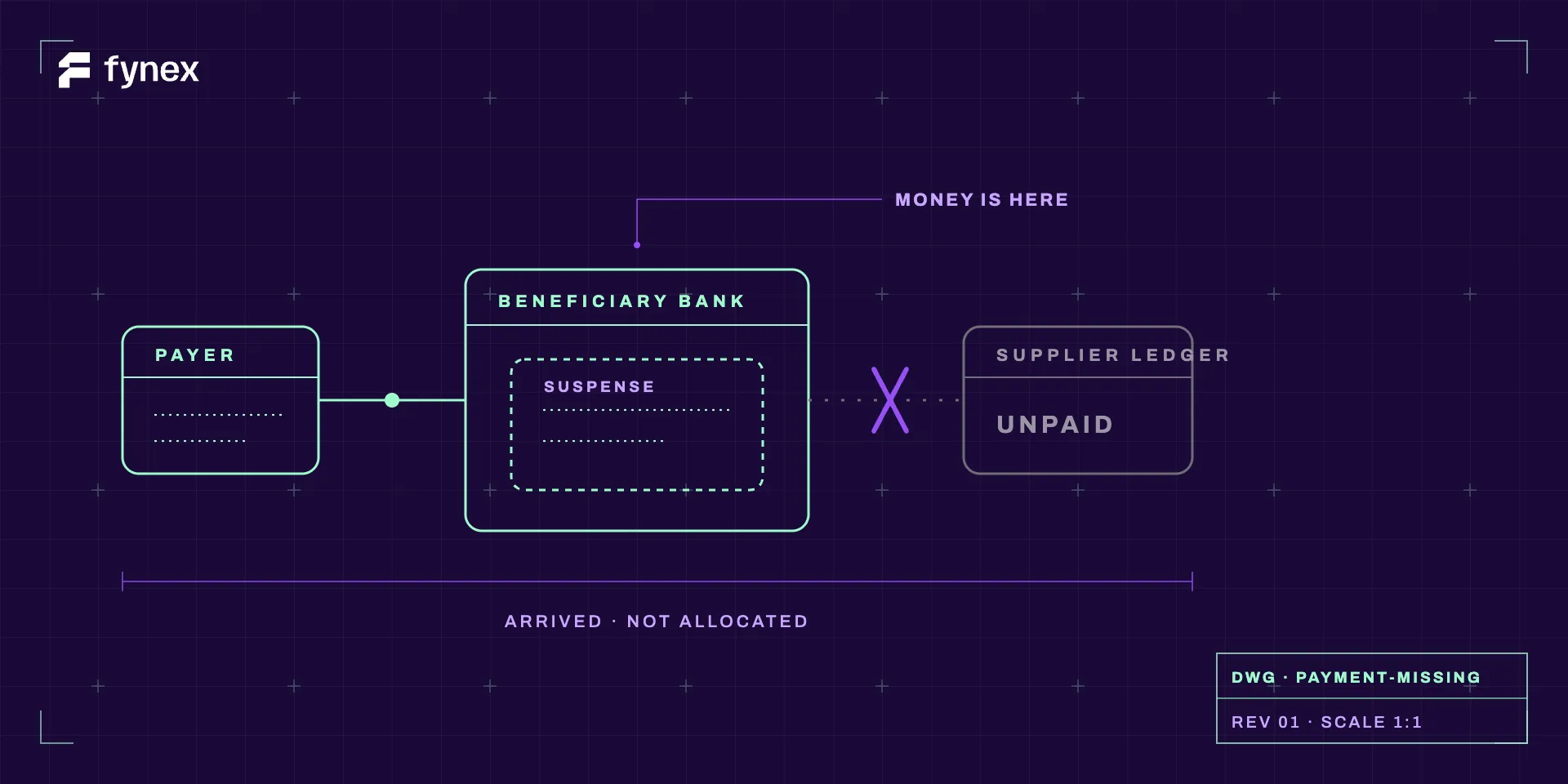
Your bank says the payment went. Your balance agrees. Your supplier’s accounts team says nothing has arrived, and there is an increasingly firm email about it.
Both of you are telling the truth. The money is almost certainly sitting somewhere specific, and finding it is a process rather than a negotiation.
First: money does not vanish
Payment systems are built so that funds have exactly three possible fates. They arrive, they are returned to the sender, or they sit unallocated at an institution waiting for a human decision.
There is no fourth outcome. So “the payment is lost” is never the right frame — the right frame is “the payment is somewhere, and I need to establish where.” That distinction changes the conversation with both your bank and your supplier from a complaint into a search.
In B2B, the overwhelmingly common answer is the third one: the money reached the supplier’s bank and could not be automatically credited or identified.
The five places it actually is
1 · Sitting in suspense on a name mismatch
The account number is valid, so the payment is not returned. But the beneficiary name on the payment does not correspond closely enough to the name registered on the account, so the receiving bank will not credit it automatically. It goes to a suspense account.
This is enormously common and almost always structural rather than a typo. A supplier trading as Northgate Services whose bank account is registered to N. G. Holdings Ltd. A sole trader invoicing under a business name with a personal account behind it. A company that was acquired and never updated its remittance details.
If it happens once with a supplier, it will happen every time until the payee record is corrected.
2 · Credited, but unallocated
The money is in the supplier’s bank account. Their finance team cannot tell what it is for.
No reference, a wrong reference, or a reference in a format their system does not recognise. Forty open invoices, one unexplained deposit. It sits in a suspense or unallocated account on their ledger, and their system continues to show you as unpaid — accurately, from their point of view.
This is the single most common “missing” B2B payment, and it is not a banking problem at all. It is a reconciliation problem happening in someone else’s accounts, which you cannot see and cannot fix directly.
The tell: they say it hasn’t arrived, but they are describing their ledger, not their bank statement. Asking “has it not arrived in the bank, or not been matched to the invoice?” resolves a surprising number of these on the first call.
3 · Held at the beneficiary bank for screening
Sanctions and AML screening runs on the receiving side too. A partial name match against a watchlist, an unusual corridor, a first payment from a new counterparty — any of these can park a payment for manual review rather than reject it.
You cannot resolve this. The supplier has to respond to their own bank. What you can do is establish that this is what happened, so nobody spends a week looking in the wrong place.
4 · Stopped in the correspondent chain
International payments routed by wire can pass through intermediary banks. Each is a separate institution with its own screening, its own cut-offs and its own capacity to hold a payment.
The tell is a payment that has left, is not with the beneficiary, and has been gone longer than the corridor’s normal timeline. This is precisely what the trace reference exists to resolve.
5 · It never actually went
Worth checking before anything else, because it costs thirty seconds and it is not rare. A payment queued for approval and never approved. A batch prepared and not submitted. A standing instruction that failed silently on insufficient funds.
Check whether the money has actually left your available balance. If it hasn’t, everything above is irrelevant and the problem is on your side.
The order to work
- Confirm the money left your available balance. No → the problem is yours, and it is in your approval queue.
- Count business days from the first processing day after your bank’s cut-off. Inside the window → it is not missing.
- Ask the supplier the precise question: has it not arrived in your bank account, or has it arrived and not been matched to the invoice? These are different problems and most people conflate them.
- Get the trace reference from your bank. For cross-border payments this is the UETR, which follows the payment across every institution that touches it. Most banks can supply it from the payment record without opening a formal investigation.
- Give the reference to the supplier. Their bank can search for an inbound item against it far faster than your bank can chase it outward. If it is in their suspense account, this finds it in minutes.
- Only then open a formal trace. A request without a reference gets a queue position rather than an answer.
Steps 3 and 5 resolve the majority of cases, and both depend on the supplier doing something rather than you. That is worth knowing before you spend an afternoon on hold.
Why this keeps happening to the same suppliers
Because none of these causes are random. A name mismatch is a property of the payee record. A reference format that their system cannot parse is a property of how you build references. A screening hit on a corridor is a property of that corridor.
Every one of them will recur on every payment until the underlying record is fixed — which means “we found it” is only half the job. The half that actually saves time is asking why this payee, and correcting the stored details rather than the individual payment.
Most businesses never do that, because the payment eventually lands, everyone is relieved, and the ticket closes. Then it happens again next month, and it is treated as a new incident.
The cost nobody counts
The direct cost of a missing payment is a few hours of admin. The real costs are elsewhere.
Supplier relationships. From their side you are simply a customer who does not pay on time. They cannot see your bank confirmation. Do it twice and you are in their credit-control process, which is a bad place to be when you need something urgently — the opposite of using paying on time as a procurement weapon.
Duplicate payments. The most expensive outcome. Under pressure, someone pays again to resolve the argument, then the original surfaces. Now you are trying to recover money from a supplier, which is materially harder than not sending it twice.
Forecasting. Money that has left your account but is not with the recipient is in a state your cash-flow model has no name for. It is spent from your side and unreceived from theirs, and it will reappear as a discrepancy at month-end.
Where Fynex fits
Fynex validates the payee before money moves, not after it fails. Account details are checked against what the beneficiary bank will actually accept, so a name mismatch is caught while it is still a form field rather than three days later in someone’s suspense account.
References are constructed to match what the recipient’s ledger needs in order to allocate the payment — because a payment that arrives and cannot be identified is, in every way that matters to the person waiting for it, a payment that has not arrived.
Every payment stays attached to the invoice it settles and carries its trace reference on the record, so “did they get it” is answered by looking rather than by emailing. And when a payment does stop — screening, mismatch, an unresponsive corridor — that surfaces as a specific state with a specific next action on the day it happens, rather than as a supplier’s complaint the following week.